A judge doesn’t care how a text message made you feel — only whether you can prove who sent it. That single requirement, authentication, decides more evidence disputes in small claims court than any other rule, and most people walk in having never thought about it.
This guide covers what “authentication” actually means, why the other party’s own texts are usually your strongest evidence, whether hearsay rules can keep your messages out, and exactly how to print and present them so a judge can rely on them.
Yes, But You Have to Clear Two Hurdles First
Text messages are routinely accepted as evidence in small claims court. But like any written evidence, they have to clear two separate tests before a judge weighs them: authentication (proving the message is really from who you say it’s from) and, less often in small claims specifically, a hearsay objection (a rule about using out-of-court statements to prove something is true). Neither test is complicated once you understand what it’s actually asking.
Authentication — Proving Who Actually Sent It
A name on a text thread isn’t enough by itself — courts have excluded messages where the only proof of who sent them was the label on the screen. You need what courts call “confirming circumstances”: something beyond the name that ties the message to a real person.
That can be a phone number that matches the person’s known number, content that only that person would know, your own testimony about the conversation, or — most simply — the fact that the other party doesn’t dispute sending it.
What About Hearsay?
Hearsay is an out-of-court statement offered to prove that what it says is true — and a text message is, by definition, made outside the courtroom. So technically, most texts are hearsay. In practice, this matters far less than it sounds.
The exception that matters most in a small claims dispute: a statement made by the other party in your case, offered against them, generally isn’t treated as hearsay at all. If the person you’re suing texted “I’ll pay you back Friday” or “yeah, I messed up the repair,” that message comes in without needing any special exception — it’s their own words, used against them.
Small claims courts also tend to apply hearsay rules loosely to begin with — the process is built to be informal and accessible without a lawyer. That’s a practical reality, not a guarantee: don’t assume every text is automatically in. Be ready to explain plainly how you know the message is genuine, and let the judge decide its weight.
How to Present Text Messages in Court
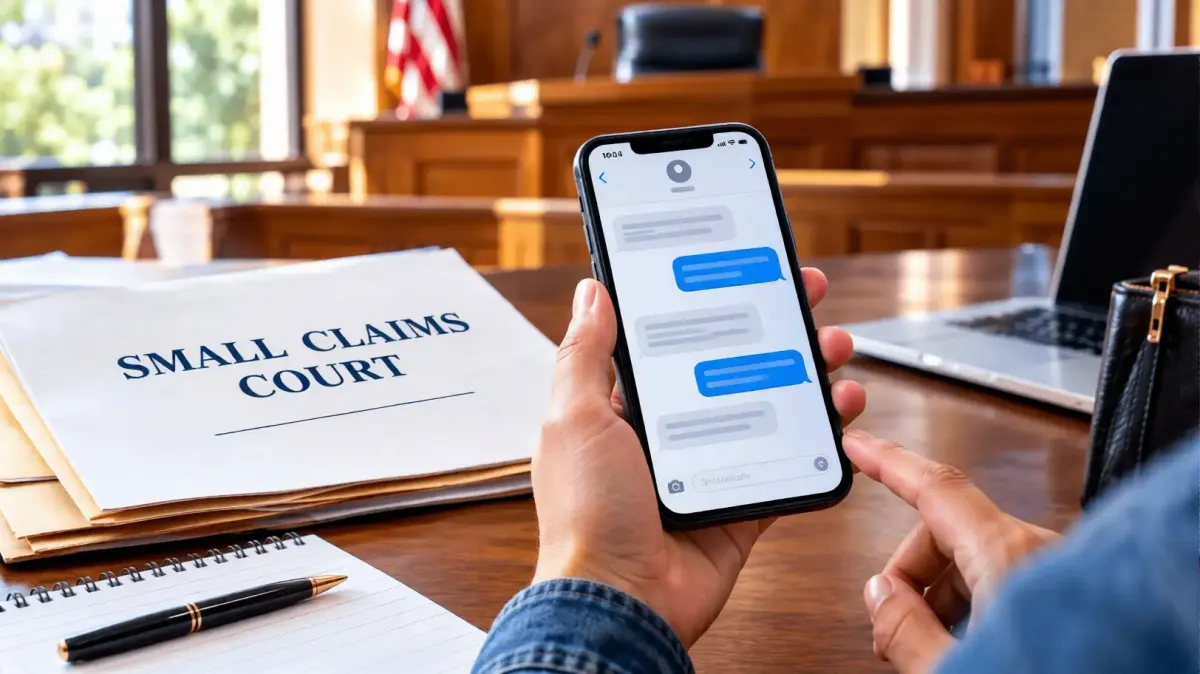
- Print them rather than just handing over your phone. Most judges want a physical exhibit they can keep in the file.
- Include the full thread, not just the messages that help you. A cropped or selective screenshot can be challenged as misleading, and judges notice when context is missing.
- Make sure the sender’s name or number and the date/time are visible in the screenshot — not cropped out to save space.
- Bring your phone as backup in case the other side questions whether the printout is accurate.
- Bring three copies — one for the judge, one for the other party, and one for yourself.
Common Mistakes
| Mistake | Why It Hurts | How to Avoid It |
|---|---|---|
| Cropping out the sender’s name or number | Judge can’t verify who actually sent it | Screenshot the full contact info, not just the message bubble |
| Only bringing a few messages from a longer thread | Opposing party can argue it’s misleading out of context | Print the entire relevant conversation |
| Building your case on your own texts | Your own out-of-court statements often face a hearsay objection | Lead with the other party’s messages, not yours |
| No visible date or time stamp | Judge can’t confirm when the message was sent | Use a screenshot that includes the messaging app’s header, not a cropped close-up |
| Using a screenshot someone else took | Weakens authentication since you didn’t witness it directly | Get the messages from the original device when possible |
| Assuming a text is automatically admitted | Evidence still has to be relevant and authenticated, not just true | Be ready to explain simply how you know who sent it |
Frequently Asked Questions About Text Message Evidence
Are text messages admissible as evidence in small claims court?
Generally, yes. Small claims courts use relaxed, informal rules of evidence, and text messages are commonly accepted as exhibits. You still need to clear authentication, and occasionally a hearsay objection, though small claims judges rarely enforce hearsay rules strictly.
Do text messages count as hearsay?
Technically, yes — a text is an out-of-court statement. But the most useful texts in a small claims case are usually the other party’s own messages, and a party’s own statement offered against them isn’t treated as hearsay. Your own texts are more likely to run into a hearsay objection than theirs.
How do I prove I actually sent or received a text message?
This is called authentication, and it doesn’t require the sender’s cooperation. You can authenticate a message yourself by testifying about the conversation, by matching the phone number, or by pointing to details in the message only that person would know.
Can I just show the judge my phone?
You can, but most courts prefer a printed copy as the actual exhibit, with your phone available as backup if the other side questions authenticity. Bring three printed copies: one for the judge, one for the other party, and one for yourself.
What if the other person deleted the text messages?
If you still have them on your device, that’s usually enough — you don’t need the other person’s copy to introduce your own. If you’ve also lost them, check for a cloud backup, or ask your carrier whether message content, not just logs, can be recovered, though this is often limited.
Can I use screenshots someone else sent me?
It’s weaker evidence than messages from your own device, since you’re now relying on someone else to vouch for what they captured. If possible, get the conversation directly from the original phone instead, or have that person available to testify to what they sent you.
Sources
- State rules of evidence on authentication and hearsay, and their treatment of statements by an opposing party
- The Evidence guide on this site
- Individual state small claims guides on this site