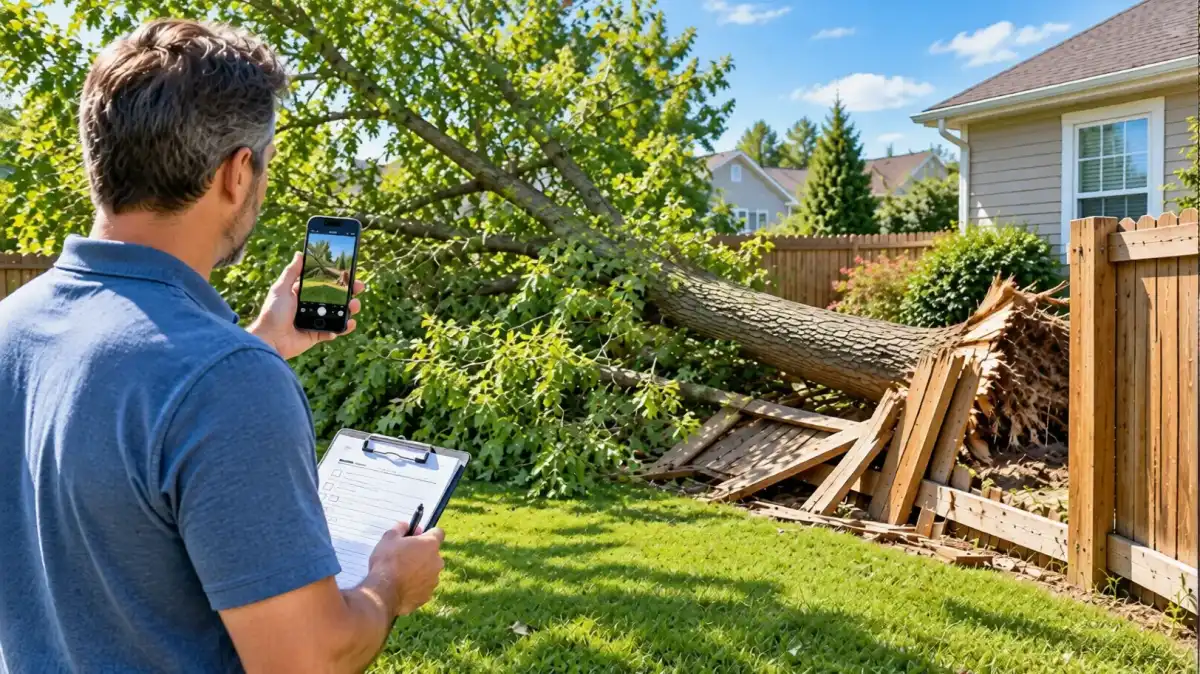
Before you think about suing, find out whether your homeowners insurance already covers this — because it might, and because that changes what you’re actually suing for. Neighbor property damage claims split into two very different categories: things nobody controls, like a storm, and things somebody caused, like a regraded yard or careless work. Only the second usually gets you anywhere in court.
This guide covers how to tell which category you’re in, why your own insurance often belongs in this process before a lawsuit does, a self-help mistake that can flip liability onto you, and what to do when it really is your neighbor’s fault.
Was This a Natural Event, or Something Your Neighbor Did?
This is the first question that decides everything. A healthy tree that fell in a storm, or rain that naturally flows downhill onto your yard, is generally treated as an act of nature — your neighbor isn’t liable just because it happened on their property first.
It’s different when your neighbor changed something: regrading their yard, adding a drainage system, paving over ground that used to absorb rain, or letting a visibly dead or diseased tree go unaddressed. States generally require the change to be “unreasonable” or the neglect to be provable before you can recover — a court will weigh how much the alteration affected you against how reasonable the neighbor’s use of their own property was.
The Exception That Changes Everything — Did They Know?
Even a tree that ultimately fell “because of the storm” can create liability if it was already dead, rotting, or visibly unstable and your neighbor knew, or reasonably should have known, before it fell.
Check Your Homeowners Insurance Before You Sue
For a lot of neighbor property damage, your own homeowners policy is the fastest path to getting made whole, regardless of who’s ultimately at fault. File the claim with your insurer, and if they determine your neighbor was negligent, your insurer can pursue the neighbor’s insurance company directly through a process called subrogation — you may never need to set foot in a courtroom.
Small claims court usually enters the picture for what insurance leaves behind: your deductible, items your policy doesn’t cover, or situations where there’s no applicable coverage on either side at all.
If You Try to Trim It Yourself — Know the Risk
You generally have the right to cut back branches or roots that cross onto your property, at your own expense, without asking permission. Where people get into trouble is what happens next.
Other Common Property Damage Disputes
Fences: Responsibility for a shared boundary fence depends on your state and any existing agreement — some states presume equal responsibility for a boundary fence, others don’t. Check your property survey and any past written agreement before assuming a 50/50 split.
Construction and repair work: If a neighbor’s contractor damaged your property during work next door, the claim usually runs against the neighbor, their contractor, or both, depending on who directed the work. Document the damage immediately, since it’s easy for the contractor and homeowner to point at each other.
Evidence to Gather
- Photos and video of the damage, from multiple angles, as soon as possible
- Two or three written repair estimates
- Any written notice you sent your neighbor before the damage occurred
- Your insurance claim file, including any denial or subrogation correspondence
- Witness statements, if anyone saw what happened
- A property survey or plat, if the dispute involves a boundary line
Common Mistakes
| Mistake | Why It Hurts | How to Avoid It |
|---|---|---|
| Suing before checking insurance | You may recover faster through subrogation, with less conflict | File your own claim first, then sue for what’s left uncovered |
| Trimming across the property line yourself | Can make you liable for double or triple damages | Stay strictly on your side, or get the neighbor’s consent first |
| Only giving verbal warnings about a hazard | Hard to prove your neighbor knew about the danger later | Put any hazard notice in writing — a text is enough |
| Assuming any water on your property is their fault | Naturally flowing water usually isn’t actionable at all | Identify what specifically changed before you assume liability |
| Waiting to get repair estimates | Costs and conditions change, weakening your documentation | Get two to three estimates while the damage is still fresh |
| Skipping the boundary survey on a fence dispute | You may be arguing about the wrong property line entirely | Pull your property survey before assuming where the line sits |
Frequently Asked Questions About Neighbor Property Damage
Can I sue my neighbor if a tree just fell during a storm?
Usually not, if the tree was healthy. Most states treat storm damage from a healthy tree as an act of nature nobody is responsible for. That changes if the tree was already dead, diseased, or visibly unstable and your neighbor knew or should have known — that’s negligence, storm or no storm.
Should I file an insurance claim or sue my neighbor?
Start with your own homeowners insurance for a covered loss — your insurer may pursue the neighbor’s insurer directly through subrogation without you ever going to court. Small claims typically comes in afterward, for your deductible, anything insurance didn’t cover, or if there’s no applicable coverage at all.
Can I get in trouble for trimming my neighbor’s tree myself?
Yes, if you’re not careful. You generally have the right to trim branches or roots up to the property line at your own expense, but crossing that line, or damaging the tree even on your own side, can make you liable to your neighbor for two to three times the actual damages in some states.
What if my neighbor’s landscaping is causing water to flood my yard?
This is treated differently than naturally flowing water. Grading, drainage systems, or paving that redirects water onto your property can create liability if a court finds the change unreasonable, even though your state’s exact legal test for “unreasonable” varies.
Who pays for a shared fence?
It depends on your state and any agreement between you and your neighbor. Some states presume equal responsibility for a boundary fence unless one owner specifically doesn’t want or need it. Check your property survey and any past written agreement before assuming a 50/50 split.
What evidence do I need for a neighbor property damage claim?
Photos or video of the damage, two or three repair estimates, any written notice you gave your neighbor beforehand about a hazard, your insurance claim file if you filed one, and witness statements if anyone saw what happened.
Sources
- State case law and statutes on tree liability, surface water rules, and boundary fence responsibility
- Homeowners insurance subrogation practices for neighbor-caused property damage
- Individual state small claims guides on this site