
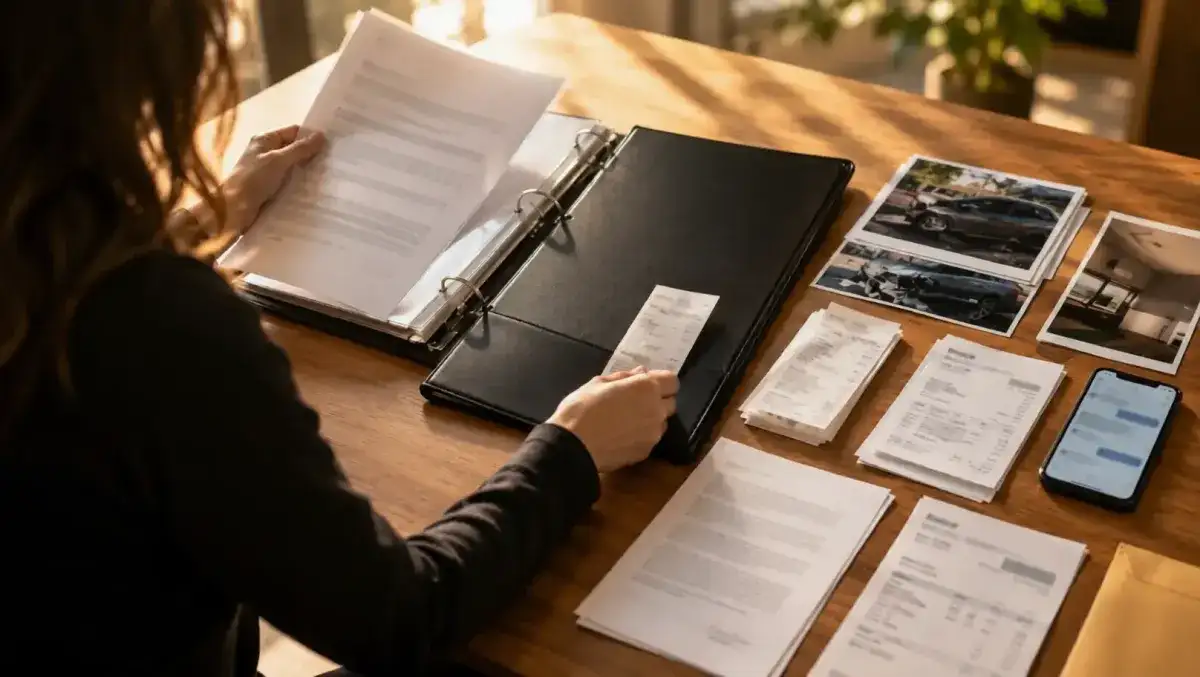
Evidence — Fast Facts
- Copies to Bring
- 3 sets — judge, defendant, yourself
- Label Your Exhibits
- Numbered: Exhibit 1, Exhibit 2…
- Witnesses
- Must appear in person in most states
- Standard of Proof
- Preponderance of the evidence
- Rules of Evidence
- Relaxed — informal but document-driven
- Best Single Piece
- A signed written agreement
The single most important thing you can do to win your small claims case is bring the right evidence, organized clearly, in three complete sets. Not the most persuasive argument. Not the most confident delivery. The evidence. Small claims court judges hear dozens of cases per session, and the outcomes consistently favor the party who walks in with documented proof over the party who walks in with a compelling story and nothing to back it up.
This guide tells you exactly what to bring to small claims court for every common case type, how to organize it so the judge can follow it easily, how to present it at the hearing, and what to do about witnesses who may not want to come voluntarily. Follow this checklist before your hearing date and you will be better prepared than most people who show up to small claims court every day.
Understanding the Standard of Proof
Small claims court uses the preponderance of the evidence standard — meaning you need to show that your version of events is more likely true than not. This is often explained as “more than 50% likely.” You do not need to prove your case beyond a reasonable doubt (that is the criminal standard). You do not need to eliminate every possible alternative explanation. You need to tip the scales in your favor — and organized documentation does that more reliably than any other factor.
Rules of evidence are relaxed in small claims court. Judges accept documents, photographs, text messages, and other materials that might be excluded in a formal civil trial. This works in your favor — almost anything relevant and authentic can be considered. The practical implication: bring everything that supports your claim, even if you are not sure whether it “counts.” Let the judge decide what weight to give it.
The Universal Evidence Checklist — Bring These to Every Hearing
Regardless of the type of case, every small claims plaintiff should bring these items:
- Your demand letter — a copy of the letter you sent before filing, proving you gave the defendant a documented opportunity to pay before going to court
- Certified mail receipt and signed return receipt card — proof that the defendant received your demand letter on a specific date
- A written timeline of events — a one-page chronology of what happened and when, prepared before the hearing so you can refer to it if the judge asks questions
- Any prior communications with the defendant — emails, texts, letters, or notes from phone calls that show the history of the dispute
- Three complete sets of everything — one for the judge, one for the defendant, one for yourself. Do not bring originals unless they are the only copy — bring photocopies and keep the originals safe
Evidence by Case Type
Security Deposit Disputes
Security deposit cases are the most common type in small claims court. The key documents are:
- Your signed lease or rental agreement — particularly the section describing the security deposit amount, conditions for return, and permitted deductions
- Move-in inspection report or checklist — the documented condition of the property when you moved in, ideally signed by both you and the landlord. This is your baseline for comparing the move-out condition.
- Move-out inspection report or checklist — if the landlord conducted a move-out inspection, bring any documentation from it
- Photographs from move-in — timestamped photos of every room, every wall, every appliance, and every area of the property when you moved in
- Photographs from move-out — the same scope of photos taken on or just before the day you left, showing the condition you left the property in
- Payment records for the deposit — your cancelled check, bank statement, or receipt showing you paid the deposit and the amount
- The landlord’s itemized deduction statement (if received) — if the landlord provided any statement of deductions, bring it. If they did not provide one when required by law, that absence is itself evidence of a statutory violation.
- Receipts for any cleaning or repairs you completed before moving out — professional cleaning receipts, hardware store purchases, or contractor invoices that show you left the unit in good condition
- The relevant state statute — print the section of your state’s landlord-tenant law that specifies the deposit return deadline and requirements. Every state guide on this site includes the applicable statute. Bring it to the hearing.
Contractor and Home Repair Disputes
- The written contract, work order, or signed estimate — the document that established what work was agreed to, at what price, and by what date. This is your most important exhibit.
- Your payment records — cancelled checks, bank statements, wire transfer confirmations, or credit card statements showing what you paid and when
- Photographs of the incomplete or defective work — taken as soon as you identified the problem, with timestamps visible
- Photographs of the original condition — if you have before photos showing the area before the contractor worked on it, bring those too
- Third-party contractor estimates — written estimates from other licensed contractors stating the cost to complete or correct the work. These are essential for establishing your damage amount. Two or three independent estimates carry more weight than one.
- Any permits or licenses — if the contractor was required to pull permits and did not, documentation of this strengthens your case
- Correspondence with the contractor — emails, texts, or letters showing you notified them of the problem and gave them an opportunity to correct it before filing suit
- Your demand letter and their response (or non-response)
Vehicle Damage Cases
- Photographs of the damage — taken immediately after the incident if possible, showing the full extent of the damage from multiple angles
- Police or accident report — if law enforcement responded to the incident, obtain the report and bring a copy. It establishes the facts of what happened and who was involved.
- Repair estimate or completed repair invoice — the documented cost of repair from a licensed repair shop. If you have already had the vehicle repaired, bring the paid invoice. If not, bring two or three written estimates.
- Photographs of the other party’s vehicle — if the damage was caused by another vehicle, photos of that vehicle at the scene help establish the circumstances
- Insurance documentation — if you filed a claim with your insurer and they determined the other party was at fault, bring any documentation of that determination. In states with mini-tort rules (like Michigan), bring documentation of what your insurance covered and what you paid out of pocket.
- Witness information — names and contact details of anyone who witnessed the incident
Unpaid Invoice / Business Debt
- The original invoice — clearly showing the services performed, the date of service, the agreed price, and the amount outstanding
- The signed contract or service agreement — if one exists. If the agreement was verbal, any written confirmation of the terms (email, text, written estimate the customer approved) becomes your key exhibit.
- Proof of work performed — delivery receipts, signed work completion forms, photographs of completed work, shipping confirmations, or time and materials logs
- Payment history — bank records or accounting statements showing what was paid and what remains outstanding
- Prior payment requests and reminders — copies of payment reminders you sent before the formal demand letter
- Any payment promises — text messages or emails where the defendant acknowledged the debt or promised to pay
Personal Loan Cases
- The written loan agreement — if you have one. Even an informal written note or email confirming the loan terms is valuable.
- Proof of the transfer — bank records, wire transfer confirmation, Venmo or PayPal transaction records, or a cashed check showing you transferred the money to the defendant
- Any repayment records — documentation of any amounts the defendant has already repaid, establishing the outstanding balance
- Communications acknowledging the loan — text messages, emails, or social media messages where the defendant confirmed they borrowed the money, agreed to repay it, or acknowledged the outstanding balance
- Any repayment promises — messages where the defendant committed to specific repayment dates or amounts that were not fulfilled
Consumer Disputes (Defective Product or Service)
- The receipt or proof of purchase — showing what you bought, from whom, at what price, and on what date
- The written warranty, guarantee, or advertisement — if the seller or manufacturer made specific representations about what the product or service would do, bring documentation of those representations
- Photographs or video of the defect — showing specifically what is wrong with the product or service
- Your communications with the seller — evidence that you reported the problem, gave the seller an opportunity to fix it, and did not receive a satisfactory resolution
- Expert or third-party assessment — if a professional has evaluated the defective product or service and can confirm the defect, bring their written assessment
- Replacement cost documentation — receipts for a replacement purchase or repair if you have already remedied the defect at your own expense
How to Organize Your Evidence
Organization is not just a cosmetic detail — it affects how the judge perceives your credibility and how efficiently the hearing proceeds. A judge who can follow your evidence file without confusion is a judge who is focusing on whether you deserve to win, not on trying to figure out what you are trying to show them.
Use Numbers, Not Letters
Label your exhibits with numbers starting at 1: Exhibit 1, Exhibit 2, Exhibit 3. Some courts prefer letters (Exhibit A, Exhibit B), but numbers are more intuitive and universally accepted. Ask the clerk how your specific court prefers exhibits labeled when you file — most simply want them clearly identified.
Create a Cover Sheet or Index
For complex cases with more than five exhibits, prepare a one-page index listing each exhibit number and a brief description of what it is. Hand this to the judge along with the exhibit set at the start of the hearing. This allows the judge to refer to specific items by number during the hearing without shuffling through a stack of papers.
Organize Chronologically
Within your exhibit set, arrange documents in the order events occurred — not in order of importance. Start with the agreement or the beginning of the relationship, then move through the dispute events, and end with the demand letter. This chronological structure makes it easy for the judge to follow the story as you tell it.
Three Identical Sets
Make three complete, identical sets — one for the judge, one for the defendant, and one for yourself. When you hand the judge Exhibit 1, the defendant gets Exhibit 1 at the same time, and you have your own copy to refer to. This prevents the chaos of the judge looking at something the defendant cannot see and vice versa.
Keep Originals at Home
Bring photocopies to the hearing, not originals, unless the original document itself is the evidence (a physical contract, a bounced check). Courts do not return exhibits. If you submit your only copy of a signed contract and it is retained with the case file, you may not get it back. Make copies and keep your originals.
What to Do About Witnesses
A witness with direct personal knowledge of the relevant facts can significantly strengthen your case — particularly when the dispute comes down to your word against the defendant’s. In most states, witnesses must appear in person and testify under oath. Written statements from witnesses — even notarized ones — carry significantly less weight than live testimony in most states, and in several states (including South Carolina and New Jersey) written statements are expressly inadmissible.
Who Makes a Good Witness
- Someone who was physically present when the agreement was made or when the incident occurred
- A neighbor or building manager who can testify to the condition of the rental unit
- A contractor or repair professional who inspected the work and can speak to its quality
- Someone who personally saw the vehicle damage at the scene
- Someone who has direct knowledge of a verbal agreement or a payment arrangement
Voluntary vs. Compelled Attendance
Ask witnesses to attend voluntarily first. Explain what the case is about, how long the hearing is likely to take, and what you need them to say. Many people will attend a 30-minute hearing as a favor, particularly if they have direct knowledge of what happened.
If a witness is unwilling to attend voluntarily but has critical knowledge, you can compel their attendance through a court subpoena. Ask the court clerk for the subpoena form and procedure. There is typically a modest fee ($6 to $25 depending on the state) and a witness fee that must be paid on the day of the hearing. Some employers require a formal subpoena before they will allow an employee to take time off for court — even cooperative witnesses may need one as a procedural matter.
Presenting Your Evidence at the Hearing
How you present your evidence matters almost as much as what you bring. A confident, organized presentation signals to the judge that your claim is well-founded and that you have prepared seriously.
Hand Up Exhibits Proactively
Do not wait for the judge to ask for documents. As you describe each element of your claim, hand up the relevant exhibit: “As you can see in Exhibit 2, the invoice dated March 1st reflects the total amount of $3,200 that remains unpaid.” Pass one copy to the judge and one to the defendant simultaneously.
Refer to Exhibits by Number
Always reference your exhibits by number when speaking: “Exhibit 3 is a photograph taken on the day I moved out, showing the condition of the kitchen.” This creates a clear record and demonstrates that you have organized your evidence rather than presenting a disorganized collection of papers.
Let the Documents Speak
When you have a strong document — a signed contract, a text message acknowledging the debt, a photograph that clearly shows the problem — point to it, let the judge read it, and stop talking. Many claimants undermine good documentary evidence by talking over it. Hand it up, reference it briefly, and let the judge absorb it.
Address the Defendant’s Evidence
When the defendant presents their evidence or makes their arguments, take notes. In your rebuttal, address each point specifically. If they show a document you have never seen, ask the judge for a moment to review it. You are entitled to respond to evidence presented against you.
Common Evidence Mistakes — And How to Avoid Them
| Mistake | Why It Hurts | How to Avoid It |
|---|---|---|
| Bringing originals instead of copies | Court may retain documents — you lose your originals | Always bring photocopies; keep originals at home |
| Not labeling exhibits | Creates confusion during hearing; judge cannot reference documents clearly | Number every exhibit before the hearing |
| Only one copy of everything | Judge must pass documents to defendant and back; interrupts flow | Always prepare three identical sets |
| Relying entirely on verbal testimony with no documents | Judge cannot verify claims; your credibility alone is not enough against a denial | Document every aspect of the claim before the hearing |
| Submitting blurry or unclear photographs | Judge cannot see what you are trying to show | Print photos at 4×6 minimum; ensure focus and lighting are clear |
| Bringing a witness statement instead of the witness | Written statements are inadmissible in several states and carry less weight in all others | Have witnesses appear in person; use subpoenas if necessary |
| Omitting your demand letter from the evidence file | Misses the opportunity to show good faith and documented prior notice | Include your demand letter and certified mail receipt as standard exhibits in every case |
| Bringing too much irrelevant material | Dilutes the strong evidence; frustrates the judge; wastes hearing time | Edit ruthlessly — only include what directly supports your claim amount |
Evidence Checklist — Print and Use Before Your Hearing
Use this checklist the night before your hearing to confirm your evidence file is complete:
- ☐ Demand letter (copy)
- ☐ Certified mail receipt and signed return receipt card
- ☐ Written contract, lease, invoice, or agreement (copy)
- ☐ Payment records (bank statements, receipts, cancelled checks)
- ☐ Photographs — clearly printed, 4×6 minimum, labeled on back
- ☐ Text messages and emails — printed with sender, recipient, and date visible
- ☐ Third-party estimates or professional assessments
- ☐ Any prior correspondence between you and the defendant
- ☐ The relevant statute from your state (security deposit, contractor licensing, consumer protection, etc.)
- ☐ A one-page written timeline of key events
- ☐ All exhibits numbered sequentially
- ☐ Three complete identical sets of everything
- ☐ Witnesses confirmed and briefed on their testimony
- ☐ Subpoenas served on any compelled witnesses (if applicable)
Sources
- Individual state small claims guides on this site (relevant statutes, deposit-return deadlines, and subpoena procedures vary by state)
- State-specific small claims court self-help resources (evidence presentation and witness rules)