
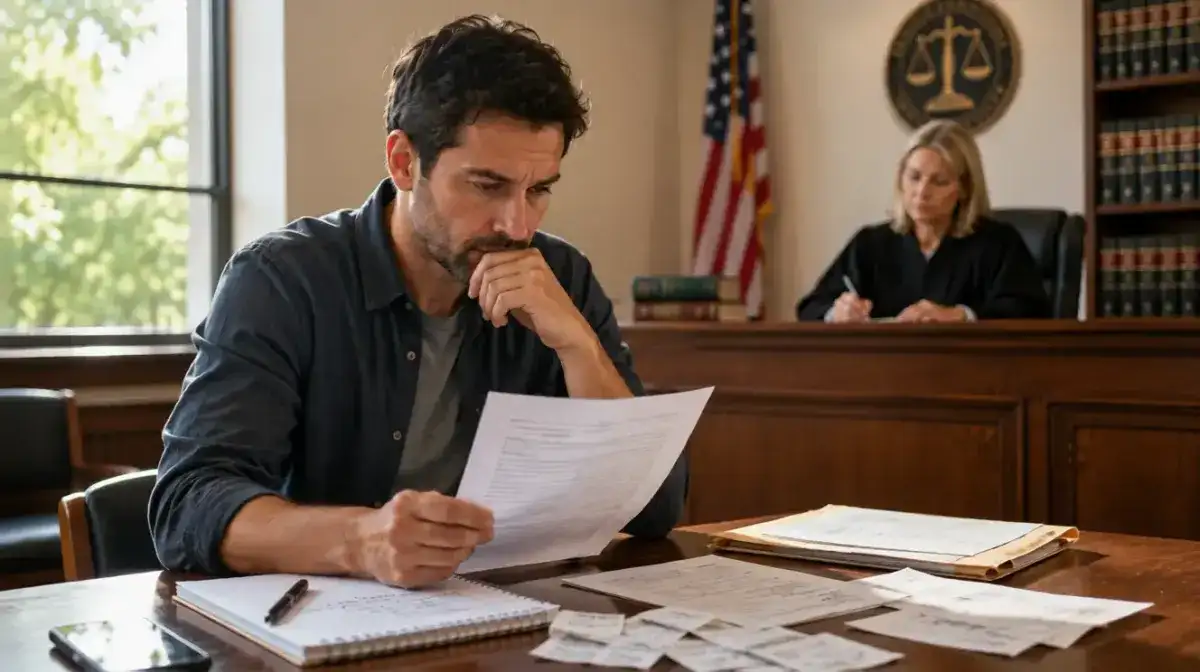
No written contract does not necessarily mean no contract. You can often sue in small claims court without a formal written agreement. A written contract can make the parties’ agreed terms easier to prove, but it is not the only form of evidence a court may consider. Oral agreements can be enforceable in every U.S. state, although certain types of agreements must be in writing and state law determines what you must prove. Text messages, emails, payment records, witnesses, and other evidence can all help establish that an agreement existed, what its terms were, and that the other party failed to perform.
The absence of a written contract means your case depends more heavily on other forms of evidence. This guide explains what an oral contract is, what you generally need to show, when a writing may actually be required, and what evidence can help support your claim.
What Counts as an Oral Contract?
An oral contract (also called a verbal contract) is an agreement made through spoken words rather than a formal written document. An enforceable oral contract generally requires the same basic elements as a written contract, including mutual agreement on sufficiently definite terms and consideration. Depending on the type of claim, state law may impose additional requirements.
In practical terms, courts often look for evidence that:
- One party proposed specific terms
- The other party agreed to those terms
- Something of value was exchanged or promised
- Both parties understood they were forming a binding agreement
When these requirements are satisfied, an oral agreement may be legally enforceable — unless another rule, such as the Statute of Frauds, requires a writing or otherwise prevents enforcement.
What You Generally Need to Show
In a typical small claims case based on an alleged oral contract, you generally need evidence showing that an agreement existed, what the parties agreed to, that you performed any obligations required of you, that the defendant failed to perform, and that you suffered the amount of damages you are claiming. The exact elements depend on the type of claim and your state’s law.
Without a written contract, each of these points must be established through other forms of evidence. The stronger and more consistent your evidence, the stronger your case is likely to appear.
When a Written Contract May Be Required — The Statute of Frauds
Certain agreements are subject to writing requirements under the Statute of Frauds. If your agreement falls into one of these categories, a purely oral agreement may not be enforceable unless an exception applies.
Agreements that commonly require a writing include:
- Real estate transactions — agreements to buy, sell, or transfer an interest in real property
- Contracts that cannot be performed within one year — agreements that by their terms cannot be fully performed within 12 months from the date they were made
- Contracts for the sale of goods for a price of $500 or more — under UCC § 2-201 (as enacted in state law). Most states retain the $500 threshold, though details can vary. Check your state’s version of the statute.
- Promises to pay another person’s debt — guarantees of someone else’s obligation
- Agreements made in consideration of marriage — such as prenuptial agreements
Exceptions and related doctrines — such as part performance, promissory estoppel, or admissions — vary significantly by state and by the type of agreement. These doctrines do not apply automatically, and their availability and effect can differ substantially between jurisdictions. If your claim may fall under the Statute of Frauds, research the specific rule that applies in your state or consult a licensed attorney.
Evidence That Can Help Prove an Oral Agreement
Text Messages and Emails
Text messages and emails can be valuable evidence in small claims cases. Depending on the court’s rules, you may need to establish that the messages are authentic and accurately represent the conversation. Keep the original messages on the device or account where possible; a screenshot is a copy of the underlying evidence.
Useful practices include:
- Screenshot the full relevant conversation, showing the contact name or phone number and dates
- Print in color when possible
- Present the complete exchange rather than only selected excerpts
- Highlight the most relevant portions on the printed copy
Payment Records
Bank statements, cancelled checks, Venmo or PayPal records, wire confirmations, or credit-card statements can corroborate your account of the agreement and show that money changed hands. By themselves, however, they may not establish why the payment was made. A transfer could be a loan, a gift, a purchase, a deposit, a repayment, or something else. Pair payment records with other evidence that explains the purpose of the transfer.
Partial Performance
Evidence that the defendant started the agreed work or partially performed can make it harder to dispute that some agreement existed. It may not, however, establish every disputed term, such as the final price, exact scope of work, or completion deadline. Document any partial performance with timestamped photographs and related communications.
Witnesses
If permitted by the court, testimony from a person who personally heard the agreement can be useful. Written statements or affidavits may be subject to different evidentiary rules and may not be accepted in every court. Confirm the local rules in advance.
Receipts, Invoices, and Similar Documents
A receipt, invoice, or similar document can help show the amount claimed and the services or goods that were allegedly provided. An invoice does not automatically become an accepted contract simply because the recipient did not respond. A recipient’s failure to dispute an invoice may be relevant in some circumstances, but silence does not automatically establish agreement to the invoice’s terms.
Prior Course of Dealing
An established history of similar transactions between the same parties can help support your account of how this particular transaction was intended to work. Bring records of prior similar payments or dealings when available.
Evidence Approaches by Common Case Type
Personal Loan Without a Promissory Note
Evidence that can help establish the claim includes: a bank or payment record showing the transfer, communications confirming the money was received, messages acknowledging that it was a loan or promising repayment, and records showing that repayment did not occur. A bank transfer alone does not establish that the money was a loan rather than a gift or another type of transaction.
Contractor or Service Dispute Without a Signed Contract
Helpful evidence often includes: messages or emails discussing the scope and price, proof of payment, photographs of the work area before and after, documentation of incomplete or defective work, and third-party estimates showing the expected cost to complete or repair the work. Estimates support a damages calculation; they do not automatically prove the final cost.
Unpaid Invoice for Services
Useful evidence can include: communications showing the work was requested, records of the work performed, the invoice itself, proof that the defendant received the benefit of the services, and communications about payment. Focus on showing the request, performance, price (agreed or reasonable), and non-payment rather than relying solely on the defendant’s silence after receiving an invoice.
Security Deposit With a Verbal Rental Arrangement
Many state security-deposit laws apply to residential tenancies even when the rental arrangement was oral, but the specific rules and deadlines vary by state. Helpful evidence often includes proof of the deposit payment, communications confirming the landlord received it, move-out documentation, and the absence of a timely proper return or itemized statement. Confirm the exact statutory requirements in your state.
How to Strengthen a Small Claims Case Without a Written Contract
- Preserve digital evidence immediately. Screenshot full conversation threads showing the agreement, performance, and any acknowledgments or failures. Keep original messages when possible and print clear copies with dates and contact information visible.
- Document your own performance. Photographs, delivery records, time logs, and payment confirmations can help corroborate your account of the agreement and the obligations you say the defendant accepted.
- Use the defendant’s own words. Messages asking when work can start, confirming an amount owed, or promising payment can serve as useful corroboration when consistent with the rest of the evidence.
- Be precise about damages. Specific, documented amounts supported by records are generally more persuasive than vague claims.
- Check the Statute of Frauds. If the dispute involves goods for a price of $500 or more, a multi-year arrangement, or another category that commonly requires a writing, determine whether the writing requirement applies and whether any exception may be available under your state’s law.
- Prepare for disputes about the existence or terms of the agreement. Organize your evidence so that it consistently supports your account of what was agreed and what occurred.
- Confirm local procedures. Evidence rules, witness requirements, and filing practices vary. Check with the court clerk about current local rules.
What If There Was No Agreement at All?
Not having a written contract is different from having no agreement of any kind. If you never reached an agreement with the defendant, you may still have a legal claim depending on the facts, but it may rest on a different legal theory than breach of contract — for example, unjust enrichment, property damage, negligence, or a statutory claim. The available theories and required proof depend on the circumstances and your state’s law.
Find Your State’s Guide
Every state has its own small claims procedures, evidence practices, and statute of limitations (which can differ depending on whether a claim is based on an oral or written agreement). Find your state’s complete guide — with forms, fees, and step-by-step filing instructions — using the By State menu above.
Related guides:
- What Evidence to Bring to Small Claims Court
- How to Write a Demand Letter
- What to Say in Small Claims Court
- Statute of Limitations for Small Claims Court
Sources
- Uniform Commercial Code § 2-201 (as enacted in state law) — writing requirement for contracts for the sale of goods
- Restatement (Second) of Contracts (Statute of Frauds and related doctrines)
- State statutes and court rules governing oral contracts, evidence, and small claims procedure
Because the UCC is enacted state-by-state and other rules vary by jurisdiction, readers should verify the current law that applies in their state.