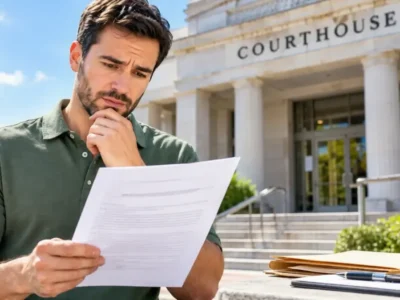

The short answer is no — you do not need a lawyer for small claims court. Small claims court was specifically designed for self-represented parties. The forms are standardized, the rules of evidence are relaxed, and the judges are experienced at managing hearings where neither side has legal representation. In most states, attorney representation is permitted but rarely appears, because the cost of hiring a lawyer almost always exceeds the financial benefit for claims under $10,000.
In several states, lawyers are not just unnecessary — they are actually restricted in some way. Arkansas has a true, no-exceptions ban. Idaho and Oregon bar courtroom representation without a judge’s consent. Some states use a “matched representation” rule instead of an outright ban — Colorado, Kansas, Mississippi, and Montana all restrict attorneys unless both sides agree, or a judge specifically permits it. For those states, self-representation is the default, not always an absolute requirement.
That said, “you don’t need a lawyer” is not the same as “a lawyer can never help you.” There are specific situations where an hour of attorney consultation before your hearing is genuinely worth the cost — and this article explains exactly when those situations arise.
States Where Attorneys Are Completely Banned
In the following states, no attorney may represent either party at the small claims hearing. Both sides must represent themselves, regardless of the stakes:
| State | Attorney Rule | Notes |
|---|---|---|
| Arkansas | Complete ban, no exceptions, for either party | Attorneys permitted only if the case is transferred to the Civil Division of District Court instead |
| Idaho | No attorney may appear in the courtroom | You may still consult an attorney beforehand for advice and document preparation |
| Oregon | No attorney without judge’s consent | After judgment, attorney may assist with collection proceedings |
| Washington State | No attorney without judge’s consent | Judge’s discretion — rarely granted in practice |
| Virginia | No attorney at the Small Claims Division hearing | Either party can request an automatic transfer to the regular civil docket before trial, unlocking attorneys immediately — not just on appeal |
| Nebraska | Lawyers may not participate at trial | Permitted specifically for post-judgment motions (new trial, setting aside a default) |
| Arizona | No attorneys without unanimous written consent from all parties | Either party can instead request a transfer to the regular civil docket to unlock attorneys |
| Hawaii | No attorneys in most cases | General money disputes are handled without attorneys as the norm |
States Using a “Matched Representation” Rule
Rather than a blanket ban or unrestricted access, these states tie attorney availability to what the other side does — if neither side has a lawyer, neither can get one; if one side brings a lawyer, the other side becomes entitled to as well:
| State | Rule | Notes |
|---|---|---|
| Colorado | Attorneys allowed only if both sides have one | If one side hires a lawyer, the other side may as well |
| Kansas | Attorneys allowed with judge’s leave, or if the opposing party is already represented | A hybrid rule combining judge’s discretion and matched representation |
| Mississippi | Attorneys allowed only if both sides agree, or the court permits it | Most parties still self-represent given the simplified procedure |
| Montana | Attorneys allowed only with mutual consent of both parties | Self-representation is the practical default absent that consent |
If you are filing or defending in any of these states, do not assume you can simply hire an attorney and show up — confirm the specific rule and any transfer or consent mechanism that applies first.
States Where Attorneys Are Freely Allowed but Rarely Appear
In most states, both sides may hire attorneys without restriction, but they rarely do — because the economics rarely make sense. For a $3,000 dispute, a lawyer charging $250 per hour for three hours of preparation and a hearing appearance costs nearly as much as the claim itself. For higher-limit states, the math gets closer — but you would still need to win to recover attorney fees, and in most states, attorney fees are not recoverable in small claims even if you win.
States where attorneys are permitted with no restrictions include California, Texas, Florida, Georgia, Ohio, Pennsylvania, Tennessee, Delaware, Indiana, Missouri, Maryland, Wisconsin, Minnesota, Massachusetts, South Carolina, Alabama, Iowa, Utah, Nebraska (at trial), West Virginia, New Hampshire, Rhode Island, and most others not listed in the tables above.
The Cost Calculation — When Does a Lawyer Make Financial Sense?
Here is the honest calculation: an attorney for a small claims case typically costs $200 to $500 for preparation and appearance, depending on the attorney and the case complexity. In most states, even if you win, you cannot recover attorney fees from the losing party — each side pays their own lawyer.
| Claim Amount | Attorney Cost (estimated) | Net Recovery After Attorney Fee | Verdict |
|---|---|---|---|
| $1,500 | $300 | $1,200 (80% of claim) | Self-represent — attorney eats 20% of your claim |
| $5,000 | $400 | $4,600 (92% of claim) | Probably self-represent — marginal benefit |
| $10,000 | $500 | $9,500 (95% of claim) | Consult worth considering for complex cases |
| $20,000 (UT / WV / MN) | $600–$1,000 | $19,000–$19,400 | Attorney likely worth it for high-stakes cases |
| $25,000 (TN / DE — tied for highest in the US) | $700–$1,200 | $23,800–$24,300 | Attorney very likely worth it at this claim size |
The break-even point shifts when:
- The case is complex and an attorney saves you from making a costly procedural error
- The other side has an attorney and you feel significantly outmatched
- The claim amount is close to the upper limit of your state’s small claims court
- Attorney fees are recoverable in your state or under a specific statute (Oklahoma, Massachusetts c. 93A, some security deposit statutes)
The Middle Ground — Consulting Without Representing
The most practical option for most small claims plaintiffs is neither full representation nor going in completely blind — it is a one-hour consultation with an attorney before the hearing.
For $150 to $300, an attorney can:
- Review your evidence file and tell you whether it is strong enough to win
- Identify the correct legal theory for your claim
- Tell you which specific statute to cite at the hearing
- Warn you if the defendant has a likely defense you have not anticipated
- Help you calculate the correct damage amount, including any statutory multipliers
- Advise you on whether to accept a pre-hearing settlement offer
The attorney does not appear at the hearing — you do that yourself. But you go in knowing exactly what you need to prove, how to prove it, and what to say when the judge asks questions. In states with attorney bans at the hearing, this is explicitly the recommended approach.
When Self-Representation Is the Right Choice
For the vast majority of small claims disputes, self-representation is not just acceptable — it is the right choice. You should represent yourself when:
- The facts are simple and well-documented. A security deposit that was not returned within the statutory deadline, an invoice that was never paid, a vehicle damaged in a clearly-established incident — these cases turn on documents, not legal arguments. Organized evidence wins them without a lawyer.
- The claim amount is modest. For claims under $3,000, the cost of attorney representation is rarely justified by the incremental benefit.
- The other side is also self-representing. If neither party has legal counsel, the hearing is a genuinely level playing field. Preparation and evidence quality determine the outcome.
- Your state restricts attorneys at the hearing anyway. In Arkansas, Idaho, Oregon, Virginia, Washington State, and others, you have no automatic choice — and in most of these states, neither does your opponent unless a specific exception applies.
- You have time to prepare thoroughly. A claimant who spends three hours organizing their evidence, reviewing the relevant statute, and practicing their presentation will outperform most opponents regardless of whether the other side has legal training.
When to Consider Getting Legal Help
There are specific situations where the cost of an attorney consultation or representation is genuinely justified:
- Claims near the upper limit in high-limit states. A $22,000 dispute in Tennessee’s $25,000 General Sessions Court or a $19,000 claim in Utah’s $20,000 Justice Court is financially significant enough to warrant professional advice.
- The defendant has brought an attorney. If you discover at the hearing that the defendant arrived with legal counsel — in states that allow it — you may request a continuance to level the playing field. In matched-representation states like Colorado, Kansas, Mississippi, and Montana, the other side hiring an attorney automatically entitles you to do the same — confirm the specific timeline for this with the court clerk if it applies to your case.
- The legal theory is complex. Disputes involving specific consumer protection statutes (Massachusetts c. 93A, for example), professional licensing violations, or claims requiring proof of willful conduct benefit from attorney guidance on the elements you need to establish.
- The defendant is a sophisticated business with legal resources. A large landlord, a franchise, or a corporation with in-house counsel will be better prepared than an individual who has never been to court. An attorney consultation helps you match their preparation level.
- You are considering an appeal. Every state’s appeal process is significantly more complex than the original small claims hearing. Appeals involve transcripts, legal briefs, and often strict procedural requirements. Most appeals from small claims are handled more effectively with an attorney. Oklahoma’s appeals go directly to the Supreme Court — virtually requiring professional assistance.
- The case involves a counterclaim that exceeds the small claims limit. If the defendant files a large counterclaim and the case transfers to regular civil court, the informal small claims rules disappear. Both sides should have attorneys at that point.
What Happens If You Show Up Without a Lawyer and the Defendant Has One
In states where attorneys are permitted, there is a real possibility the defendant brings legal counsel to your small claims hearing. Here is what you need to know:
Judges in small claims courts are experienced at managing this dynamic. They will not allow an attorney to run roughshod over a self-represented party. In many states, the judge explicitly manages hearings to ensure unrepresented parties have a fair opportunity to present their case. The informal rules still apply — you will have your turn to speak, present evidence, and rebut the defendant’s arguments.
That said, an attorney can:
- Make targeted objections to your evidence
- Ask the judge to hold you to stricter proof standards
- Present legal arguments about which statute applies or how damages should be calculated
- Cross-examine your witnesses in ways that challenge their credibility
The best defense against a represented opponent is the same as the best offense in any small claims case: a strong evidence file, a clear presentation, and thorough preparation. Bring your documents, know your facts, cite the relevant statute, and let the judge evaluate the evidence. A judge with a pile of organized, documented evidence in front of them and a defendant’s attorney making procedural arguments will frequently rule for the prepared self-represented party.
Corporations and Business Entities — Special Rules
If you are filing on behalf of a business rather than as an individual, the rules change in some states:
- Most states: A corporation or LLC may appear through an authorized officer or employee — no attorney required.
- Indiana: For claims above $1,500, a corporation needs an attorney. Below $1,500, an authorized officer or employee can represent the entity.
- Mississippi and Montana: A corporation, like any party, may only have an attorney if both sides agree, or the court permits it — the same matched-representation rule that applies to individuals.
- Ohio: Corporations face restrictions on presenting testimony and evidence at contested hearings — an attorney is advisable.
- Kansas: Corporations may use small claims court and follow the same hybrid attorney rule as individuals — permitted with a judge’s leave, or once the opposing party is already represented.
- Arkansas: Corporations and partnerships generally cannot be plaintiffs at all, with a narrow exception for a “closely held corporation” (three or fewer stockholders, or 85%+ family-held voting stock) not primarily engaged in lending money — and even then, only through a non-attorney officer.
- Delaware: Corporations cannot self-represent at all and must retain an attorney — a genuine reversal of the typical rule found in almost every other state.
- Rhode Island: Corporations generally need an attorney, except for a “close corporation” with assets under $1 million.
If you are filing a small claims case on behalf of your business, check your state’s specific guide on this site for the corporate representation rules before filing.
The Bottom Line
For most small claims disputes — a withheld security deposit, an unpaid invoice, vehicle damage, a personal loan — you do not need a lawyer and you will not be at a disadvantage without one. The system is designed for you to handle this yourself. Follow the steps in your state’s guide, bring organized documented evidence in three sets, arrive on time, dress professionally, and present your case directly to the judge. Those four things — consistently done — win small claims cases without lawyers every single day in every state in this country.
Reserve the attorney consultation for cases where the stakes are high, the legal theory is complex, or the other side has brought professional firepower. For everything else, you have this.
Find your state’s complete guide — with the exact forms, fees, and procedures — using the By State menu above.