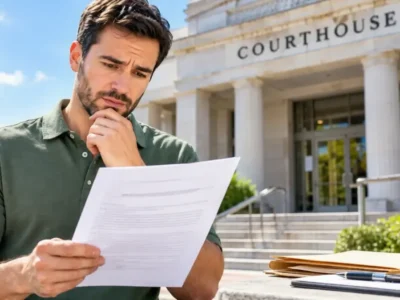

You can sue someone in another state in small claims court — but whether it is practical depends entirely on where the lawsuit must be filed. Small claims courts are courts of limited jurisdiction, meaning they can only hear cases where they have legal authority over the defendant. That authority — called personal jurisdiction — is generally established by where the defendant lives, where they do business, or where the dispute occurred. The answer to “can I sue?” is almost always yes. The harder question is “where do I have to file?” — and the answer is frequently not the state where you live.
This guide explains the jurisdiction rules that determine where a cross-state small claims case must be filed, which states give you the most flexibility, what long-arm statutes mean in practice, and when the cost and logistics of filing in another state make alternatives more practical than a lawsuit.
The Core Rule — Where Must the Case Be Filed?
Every small claims court has jurisdiction over defendants who:
- Live or reside in the court’s geographic area (county, township, or judicial district)
- Have a place of business in the court’s geographic area
- Committed the act giving rise to the dispute within the court’s geographic area
- Entered into or were to perform a contract within the court’s geographic area (in most states)
If the defendant lives in Texas and you live in California, you generally must file in Texas — the state where the defendant resides. Filing in your home state’s small claims court against an out-of-state defendant who has no connection to your state will result in dismissal or a judgment the defendant can challenge as unenforceable.
When Can You File in YOUR State Against an Out-of-State Defendant?
Your home state’s small claims court has jurisdiction over an out-of-state defendant when that defendant has sufficient “minimum contacts” with your state. This is where long-arm statutes become relevant.
What Is a Long-Arm Statute?
Every state has a long-arm statute — a law that allows the state’s courts to exercise jurisdiction over out-of-state defendants who have engaged in specific activities within the state. Common activities that trigger long-arm jurisdiction include:
- Transacting business in your state — the defendant sold goods, provided services, or operated commercially within your state
- Committing a tort in your state — the defendant’s negligent or wrongful act caused harm within your state (a car accident that happened in your state, property damage that occurred at your address)
- Contracting to perform work in your state — the contract specified that performance would occur at your location in your state
- Owning or using property in your state — the dispute involves real or personal property located in your state
If any of these apply, your home state’s small claims court may have jurisdiction over the out-of-state defendant — meaning you can file at home rather than traveling to their state.
Practical Examples of Long-Arm Jurisdiction
| Scenario | Where to File | Why |
|---|---|---|
| You hired a contractor from another state who came to your home and did defective work | Your state — where the work was performed | Defendant performed the contract in your state |
| You bought a product online from an out-of-state seller who shipped a defective item to you | Either state — depends on your state’s long-arm statute | Transaction may have occurred in seller’s state; delivery in yours |
| An out-of-state driver caused a car accident in your state | Your state — where the tort occurred | Accident happened within your state’s jurisdiction |
| You loaned money to someone who later moved to another state | Either their current state or where the loan was made | Loan was made in the original state; defendant now resides elsewhere |
| An Airbnb host in Florida kept your security deposit and you live in New York | Florida — where the property is located | Dispute arises from property in Florida; landlord-tenant law of Florida applies |
| A freelancer in another state completed remote work for you that was inadequate | Defendant’s state most likely | Work was performed in defendant’s state; no physical presence in yours |
Online Transactions and Remote Services
Online disputes are the most common source of cross-state small claims confusion — and the most fact-specific. There is no universal rule. Courts look at the totality of the defendant’s connections to your state.
When Your State Likely Has Jurisdiction Over an Online Seller
- The seller actively marketed to customers in your state (targeted advertising, ships to your state routinely)
- The seller has a registered business or agent in your state
- The contract specifically required delivery or performance in your state
- The seller’s terms of service include a venue clause specifying your state
When the Seller’s State Is More Likely Required
- The seller is a one-time seller with no ongoing business presence in your state
- The transaction was a single isolated sale with no other contacts to your state
- The seller’s terms of service specify a different venue (see below)
What Happens If You Must File in Another State
If jurisdiction requires you to file in the defendant’s state, you face three practical challenges:
1. Filing the Case Remotely
Most small claims courts require in-person filing. A few states — Iowa, New Hampshire, and some Kentucky counties — allow electronic filing that can be done from anywhere. For most states, you must either appear in person at the out-of-state court or mail the filing with the required forms, fee, and a self-addressed envelope for the court to return your stamped copy. Call the court clerk before attempting to file by mail — not all courts accept mailed filings.
2. Attending the Hearing
This is the most significant practical barrier. If you file in Texas and you live in California, you must appear in the Texas courthouse on your hearing date. If you do not appear, your case is typically dismissed. Some states allow telephone or video appearance by the plaintiff in some circumstances — ask the court clerk when you file whether remote appearance is permitted.
States that expressly allow or facilitate remote plaintiff appearance in small claims include:
- California — remote appearance by telephone or video is permitted in many counties
- Colorado — some courts allow video appearance by prior arrangement
- New York — some courts allow telephone appearance in limited circumstances
- Utah — the ODR (Online Dispute Resolution) process allows some cases to resolve entirely online without appearing
For most other states, check with the specific court before filing — pandemic-era remote appearance policies were adopted in many jurisdictions and some have remained in place.
3. Enforcing the Judgment in Your State
Even after you win in another state’s small claims court, collecting may require additional steps. To enforce an out-of-state judgment, you typically need to domesticate it — file it in your home state’s court system as a judgment of that state. The process varies but generally involves:
- Obtaining a certified copy of the judgment from the court where you won
- Filing it in the equivalent court in your home state (or the state where the defendant’s assets are located)
- Paying a modest filing fee
- Giving the defendant notice
- Proceeding with enforcement (garnishment, levy, lien) once domesticated
The Full Faith and Credit Clause of the US Constitution requires every state to honor valid judgments from other states. A judgment from Texas small claims court is enforceable in California — but you must go through the domestication process first.
State-Specific Rules for Out-of-State Defendants
Several states have specific provisions worth knowing if you anticipate a cross-state dispute:
| State | Out-of-State Filing Rule | Notes |
|---|---|---|
| Idaho | File where defendant resides — if ALL defendants out-of-state, file where cause of action arose | One of the clearer statutory statements of this rule |
| California | File where defendant resides, has principal office, or where contract was to be performed / injury occurred | Multiple venue options — most flexible in the series |
| Tennessee | File where defendant resides or where the cause of action arose | High $25,000 limit makes filing remotely more worthwhile |
| New York | File where defendant resides, has office, or where transaction occurred | NYC small claims allows service by certified mail within state |
| Texas | File in county where defendant resides or where dispute occurred | $20,000 limit — worth traveling for large claims |
| Minnesota | File where defendant resides; if out-of-state, where claim arose or defendant’s agent located in state | Conciliation Court — strong consumer protection niche |
The Cost-Benefit Calculation
Before filing in another state, run this simple calculation:
| Cost Item | Estimated Amount |
|---|---|
| Filing fee in the other state | $30 – $200 |
| Round-trip travel (flights, hotel if overnight) | $200 – $800+ |
| Lost wages for hearing day | Variable |
| Domestication filing if you win | $50 – $150 |
| Total cost estimate | $280 – $1,150+ |
If your claim is $500, filing in another state costs more than you can recover. If your claim is $5,000, the math may work. If your claim is $10,000 or above in a high-limit state, it almost certainly makes financial sense.
The break-even threshold for cross-state small claims is generally around $1,500 to $2,000 — below that, the travel and logistics costs consume the recovery. Above that, evaluate on a case-by-case basis.
Alternatives to Filing in Another State
Option 1 — Demand Letter and Credit Card Chargeback
For online purchases, a credit card chargeback may be available within 60 to 120 days of the transaction for goods not received or significantly not as described. This is faster, free, and does not require filing in another state. Try the chargeback first before pursuing small claims for e-commerce disputes under $1,000.
Option 2 — File a Complaint With the State Attorney General
Every state has a consumer protection division of the Attorney General’s office. Filing a complaint against an out-of-state seller with both their state’s AG and your state’s AG costs nothing and sometimes produces results — particularly for pattern-of-conduct sellers who have harmed multiple consumers.
Option 3 — Better Business Bureau and Platform Reporting
For disputes with businesses operating through platforms (Amazon, Etsy, Airbnb, Upwork, eBay), the platform’s dispute resolution process often produces faster results than cross-state small claims for amounts under $500.
Option 4 — File in Federal Small Claims (Not Widely Available)
The United States does not have a federal small claims court. Federal district courts do not handle small-dollar civil disputes. There is no “federal small claims” option for cross-state disputes.
Option 5 — Online Arbitration Clauses
Many commercial contracts include mandatory arbitration clauses. If the seller’s terms include arbitration, small claims court may not be an option regardless of where you try to file — though some states carve out small claims court from arbitration enforcement. Check the terms and consult a local attorney if arbitration appears mandatory.
Frequently Asked Questions
Can I sue an online seller from another state in my local small claims court?
Sometimes. If the seller regularly does business in your state, delivered goods to your state, or if the transaction otherwise created minimum contacts with your state under your state’s long-arm statute, your local court may have jurisdiction. The safest approach: review the seller’s terms of service for a venue clause, and call your local small claims court clerk to describe the facts and ask whether your court would have jurisdiction.
Can I sue a company headquartered in another state if they have offices in my state?
Yes — generally. A corporation that maintains offices, employees, or a registered agent in your state is considered to be “doing business” there. Your state’s small claims court typically has jurisdiction over disputes arising from that business activity. File where the company’s local office is located or where your dispute occurred, not at the company’s headquarters in another state.
What if the defendant moved out of state after the dispute arose?
In most states, jurisdiction is determined by the facts at the time the dispute arose — not by where the defendant lives when you file. If the dispute occurred in your state, or if the defendant lived in your state when the dispute arose, your home state’s courts may retain jurisdiction even after the defendant moves away. Confirm with the clerk in your specific state whether jurisdiction is assessed at the time of the dispute or at the time of filing.
Can the defendant challenge my lawsuit because I filed in the wrong state?
Yes — and they can do so even after you win. A judgment entered by a court that lacks personal jurisdiction over the defendant is void. If the defendant challenges jurisdiction and proves your court had no authority over them, the judgment is invalidated. This is why the jurisdiction analysis matters before you file — not after.
What if the dispute involves real property in another state?
For disputes involving real property — a security deposit on a rental you lived in, damage to property, or landlord-tenant matters — you typically must file in the state where the property is located. This is one of the clearest jurisdictional rules in civil procedure. The courts of the state where the property sits have jurisdiction over disputes about that property, regardless of where you or the landlord now live.
The Bottom Line
You can sue someone in another state — but you will almost always have to file where they are, not where you are, unless the dispute has specific connections to your state. The key questions to ask before filing any cross-state small claims case are:
- Where did the dispute occur or where was the contract to be performed?
- Does my state have a long-arm statute that reaches this defendant’s conduct?
- Did the defendant’s terms of service specify a particular venue?
- Is the amount at stake large enough to justify travel to another state’s courthouse?
- Does the other state allow remote or video appearance for out-of-state plaintiffs?
If the answers point to filing in another state and the amount justifies it, our state-by-state guides cover the exact filing procedure for every state. Use the By State menu above to find the complete guide for the state where you need to file.
Sources
- International Shoe Co. v. Washington, 326 U.S. 310 (1945) — foundational personal jurisdiction standard
- US Constitution, Article IV, § 1 (Full Faith and Credit Clause)
- Uniform Enforcement of Foreign Judgments Act — adopted by 47 states
- State long-arm statutes confirmed from individual state legislature websites for all 50 states
- Individual state small claims venue rules — confirmed from official state court self-help pages